
Description
The Poisson lognormal model and variants (Chiquet et al. 2021) can be used for a variety of multivariate problems when count data are at play. This package implements efficient variational algorithms to fit such models, accompanied with a set of functions for visualization and diagnostic. See all the dedicated vignettes for a comprehensive introduction.
PLNmodels covers the following models, all built around the multivariate Poisson-lognormal distribution and sharing a common formula-based interface (covariates, offsets, weights) and a choice of optimization backends (a fast built-in Newton solver, NLOPT, and an experimental torch backend):
- PLN (Aitchison and Ho 1989): unpenalized multivariate Poisson regression, with several covariance structures (full, diagonal, spherical, fixed, or a genetic/heritability structure).
- PLNPCA (Chiquet et al. 2018): probabilistic Poisson PCA — a rank-constrained covariance for dimension reduction and visualization.
- PLNLDA: Poisson lognormal discriminant analysis (Fisher 1936) for the supervised classification of count data.
- PLNnetwork (Chiquet et al. 2019): sparse inverse-covariance (network) inference via a graphical-lasso-like penalty (Friedman et al. 2008).
- PLNmixture: model-based clustering (Fraley and Raftery 1999) of count data via a mixture of PLN models.
-
ZIPLN (Batardière et al. 2025): a zero-inflated extension of PLN for data with excess zeros, with the same family of covariance structures and an optional sparse (
ZIPLNnetwork) variant (Tous et al. 2025).
Installation
PLNmodels is available on CRAN. The development version is available on GitHub.
install.packages("PLNmodels")             # last stable version, from CRAN
remotes::install_github("pln-team/PLNmodels")            # development version, from GitHub
remotes::install_github("pln-team/PLNmodels@tag_number")  # a specific tagged release
Illustration
We illustrate the main models on the barents data set (Fossheim et al. 2006): the abundance of 30 fish species observed in 89 sites in the Barents sea, along with depth, temperature and geographic coordinates for each site.
data(barents)
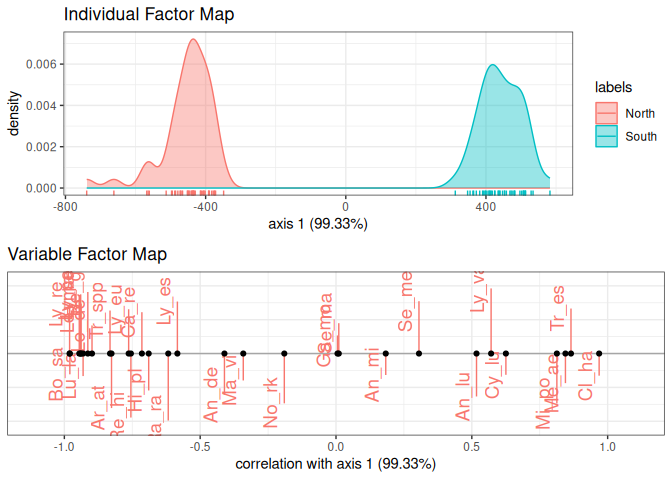
## a simple North/South split of the sites, used below to illustrate PLNLDA
barents$zone <- factor(ifelse(barents$Latitude > median(barents$Latitude), "North", "South"))
PLN: fit and inspect the covariance structure
 Initialization...
 Adjusting a full covariance PLN model with nlopt optimizer
 Post-treatments...
 DONE!
myPLNA multivariate Poisson Lognormal fit with full covariance model.
==================================================================
nb_param loglik BIC AIC ICL
555 -4412.201 -5657.797 -4967.201 -8203.81
==================================================================
* Useful fields
$model_par, $latent, $latent_pos, $var_par, $optim_par
$loglik, $BIC, $ICL, $loglik_vec, $nb_param, $criteria
* Useful S3 methods
print(), coef(), sigma(), vcov(), fitted()
predict(), predict_cond(), standard_error()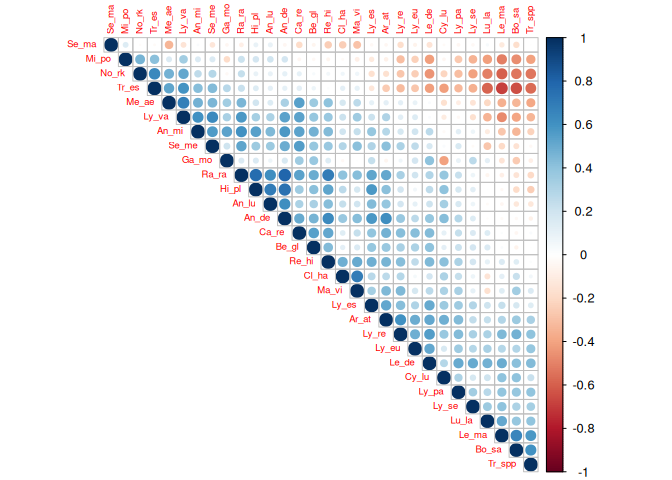
PLNPCA: dimension reduction
myPCAs <- PLNPCA(Abundance ~ Depth + Temperature + offset(log(Offset)), data = barents, ranks = 1:5) Initialization...
Adjusting 5 PLN models for PCA analysis.
Rank approximation = 1
Rank approximation = 2
Rank approximation = 3
Rank approximation = 4
Rank approximation = 5
Post-treatments
DONE!
myPCA  <- getBestModel(myPCAs)
factoextra::fviz_pca_biplot(
  myPCA, select.var = list(contrib = 10), col.ind = barents$Temperature,
  title = "Biplot (10 most contributing species, sites colored by temperature)"
) + ggplot2::labs(col = "Temperature") + ggplot2::scale_color_viridis_c()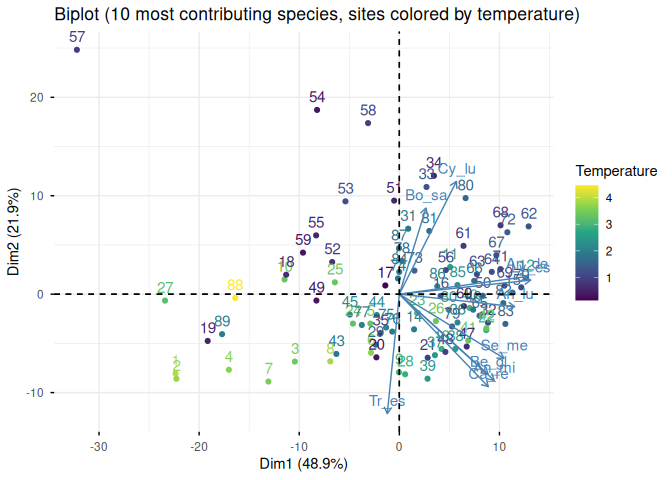
PLNnetwork: sparse network inference
myNets <- PLNnetwork(Abundance ~ Depth + Temperature + offset(log(Offset)), data = barents) Initialization...
Adjusting 30 PLN with sparse inverse covariance estimation
Joint optimization alternating gradient descent and graphical-lasso
sparsifying penalty = 0.5329204
sparsifying penalty = 0.492243
sparsifying penalty = 0.4546705
sparsifying penalty = 0.4199659
sparsifying penalty = 0.3879103
sparsifying penalty = 0.3583014
sparsifying penalty = 0.3309526
sparsifying penalty = 0.3056912
sparsifying penalty = 0.2823581
sparsifying penalty = 0.2608059
sparsifying penalty = 0.2408988
sparsifying penalty = 0.2225112
sparsifying penalty = 0.2055272
sparsifying penalty = 0.1898394
sparsifying penalty = 0.1753492
sparsifying penalty = 0.1619649
sparsifying penalty = 0.1496023
sparsifying penalty = 0.1381833
sparsifying penalty = 0.1276358
sparsifying penalty = 0.1178935
sparsifying penalty = 0.1088948
sparsifying penalty = 0.100583
sparsifying penalty = 0.09290554
sparsifying penalty = 0.08581414
sparsifying penalty = 0.07926402
sparsifying penalty = 0.07321387
sparsifying penalty = 0.06762551
sparsifying penalty = 0.06246372
sparsifying penalty = 0.05769591
sparsifying penalty = 0.05329204
Post-treatments
DONE!
plot(getBestModel(myNets), remove.isolated = TRUE)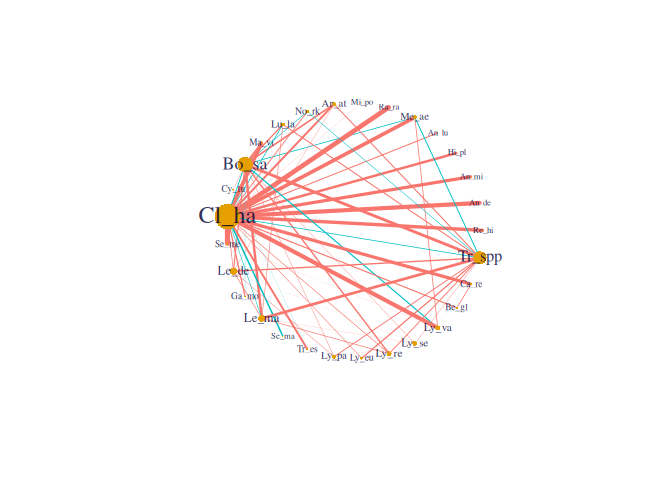
PLNmixture: model-based clustering
my_mixtures <- PLNmixture(Abundance ~ offset(log(Offset)), data = barents, clusters = 1:4,
                           control = PLNmixture_param(smoothing = "none"))
Initialization...
Adjusting 4 PLN mixture models.
number of cluster = 1
number of cluster = 2
number of cluster = 3
number of cluster = 4
Post-treatments
DONE!
myMixture <- getBestModel(my_mixtures)
plot(myMixture, "pca", main = "Clustering membership in the individual factor map")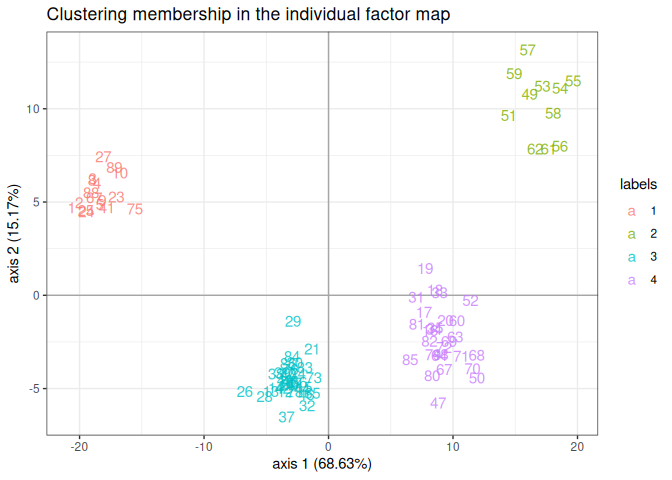
table(cluster = myMixture$memberships, zone = barents$zone)Note on the use of generative AI
The models implemented here (their definition and every algebraic derivation) were worked out by Mahendra Mariadassou, Stéphane Robin and Julien Chiquet, who also designed the algorithms, the package and its object-oriented architecture, and have been developing the code for years. More recently (since summer 2026), we have used generative AI (Claude Sonnet and Claude Opus) to improve the documentation and to audit, test and improve the code – in particular to port several algorithmic components to C++.